When Dubai homeowners start researching outdoor shading solutions, two options consistently come up side by side: pergolas and awnings. Both provide outdoor shade. Both are widely installed across Dubai residential and commercial properties. But they serve quite different purposes, perform very differently in UAE climate conditions, and suit different types of outdoor spaces and lifestyle requirements. If you are trying to decide between the two for your Dubai property, this honest, practical comparison will help you make the right choice.
What Is an Awning?
An awning is a retractable or fixed fabric cover that extends outward from a wall or building facade, typically supported by folding arms or a cassette roller system. Awnings are most commonly attached above windows, patio doors, or terrace openings to provide shade immediately outside those openings. Retractable awnings can be rolled back when shade is not needed, allowing full sunlight when preferred. They are available in a wide range of fabric colours and in motorized or manual configurations. In Dubai, awnings are a common shading solution for apartment balconies, ground-floor terrace doors, and small outdoor seating areas where a compact wall-attached solution is more practical than a freestanding structure.
What Is a Pergola?
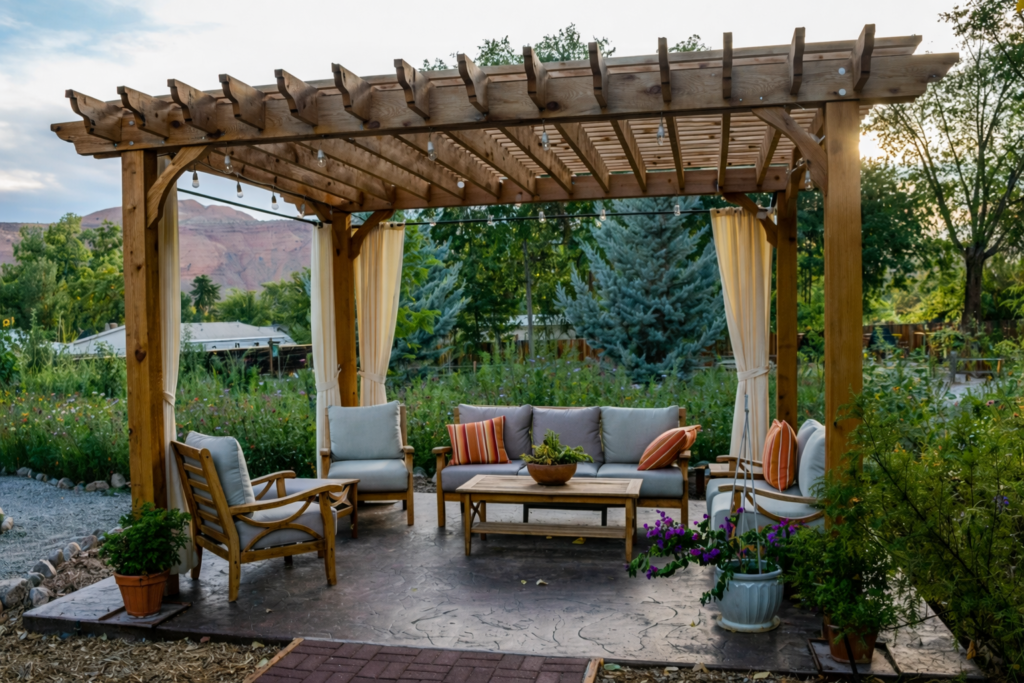
A pergola is a permanent structural outdoor shading system with its own framework of posts and beams, supporting a roof of various types including solid aluminium panels, adjustable louvres, fabric canopies, or timber slats. Unlike an awning, a pergola is a self-supporting structure that defines a specific outdoor space rather than simply extending shading from a building wall. Pergolas are significantly more substantial than awnings, considerably more durable in Dubai’s climate, and capable of covering much larger areas with greater shade performance. Our pergola work in Dubai covers the full spectrum from compact residential terrace structures to large commercial shading systems for hotels, restaurants, and resort properties across the UAE.
Coverage Area: Pergola Wins Clearly
The most significant practical difference between awnings and pergolas in Dubai is the area each can meaningfully cover. A typical retractable awning has a maximum projection of 3 to 4.5 metres from the wall it attaches to, and a maximum width limited by the structural capacity of the wall attachment and the folding arm mechanism. For most Dubai terrace situations, this means an awning can shade an area of perhaps 3 by 4 metres at most — enough to cover a small bistro table or a narrow strip of paving immediately outside a door.
A pergola, by contrast, can be designed to any size the site allows — covering pool decks of 12 metres or more in length, wrapping around multiple aspects of a garden in an L-shaped or corner configuration, and creating genuinely large covered outdoor living areas that accommodate dining, lounging, outdoor kitchens, and all the furniture and activity that a real outdoor room requires. For Dubai homeowners who want to shade a meaningful outdoor living area rather than just a narrow strip, a full outdoor pergola installation is almost always the more appropriate and ultimately more satisfying solution.
Durability and Lifespan in Dubai’s Climate
This is where the comparison becomes most consequential for Dubai property owners thinking about long-term value for money. Awning fabrics in Dubai are subject to some of the most intense UV radiation in the world, frequent sandstorm exposure that abrades fabric fibres, and occasional strong wind events that stress the folding arm mechanisms. Quality outdoor awning fabrics rated for UAE conditions will typically last 5 to 8 years before colour fading, fabric degradation, and reduced water resistance make replacement both necessary and visually obvious. The mechanical folding arm systems also require periodic maintenance and lubrication, and can fail in strong wind events if not retracted in time.
A quality aluminium pergola installed by Modern Shade will typically last 20 to 25 years or more with minimal maintenance beyond occasional cleaning. The powder-coated aluminium frame does not rust, does not fade significantly when a UAE-rated coating is correctly specified, and the structural connections do not wear or require servicing in the way that mechanical awning arm systems do. When you factor in the cost of replacing awning fabrics every 5 to 8 years over a 20-year comparison period, the total cost of ownership comparison often favours the pergola considerably more than the headline installation cost difference initially suggests. Our aluminium pergola installation clients consistently report genuine satisfaction with the long-term value their structure has delivered.
Wind Performance in Dubai’s Shamal Conditions
Dubai experiences Shamal winds that can be strong and sustained, particularly during the spring and early summer months, and this is an important consideration when comparing the real-world performance of awnings and pergolas. Shade sails and awnings present large fabric surfaces to the wind, and most retractable awning systems have a maximum recommended wind speed beyond which they must be retracted to avoid damage to the fabric or the folding arms — typically around 30 to 40 kilometres per hour. In practice, this means that during many Dubai wind events, your awning needs to be rolled back to protect it, leaving your outdoor space completely exposed at precisely the times when you most want protection from blowing sand and dust.
A properly engineered pergola structure, designed by experienced pergola contractors in the UAE with UAE wind loading specifically accounted for in the structural design, remains in place providing shade and protection during all but the most extreme weather events. A motorized louvered bioclimatic system can even be programmed with a wind sensor that automatically adjusts the louvre angle to reduce wind loading on the structure during strong gusts, allowing the structure to remain operational and providing overhead coverage even in gusty conditions.
Aesthetic Quality and Property Value
From a purely aesthetic perspective, a well-designed pergola makes a very different visual statement than an awning. An awning, particularly a retractable one in its extended position, looks like a functional addition to a building — it is clearly supplementary rather than integral to the overall outdoor space design. A pergola, by contrast, becomes a genuine architectural element of the property. It defines space, creates structure in the garden, and when well-designed in the right proportions and colour relative to the building, looks as though it was always intended to be part of the property rather than added on later.
This aesthetic difference translates into real property value. Dubai villa buyers and tenants actively seek out properties with quality outdoor living spaces, and a professionally designed and installed pergola is considered a genuine value addition in the UAE property market. Our pergola supply and installation service has delivered outdoor structures that clients have specifically credited with improving their property’s market performance when selling or renting. An awning simply does not deliver the same level of property value enhancement.
When an Awning Is the Right Choice
In the interest of complete honesty: awnings do have their place in Dubai’s outdoor shading market and are the right solution in certain specific situations. For apartment balconies where there is no space or structural permission for any kind of freestanding or wall-frame pergola structure, a quality motorized retractable awning is often the only practical shading option and genuinely improves the usability of the space within those constraints. For very small terrace areas immediately outside a single door or window where the primary need is simply to shade that opening during the afternoon hours, a compact awning can be more practical and cost-effective than commissioning a full pergola installation. For temporary shading requirements or rental properties where a permanent structural installation is not appropriate, awnings offer a more reversible solution.
The Bottom Line for Dubai Property Owners
For most Dubai villa owners and commercial property operators making a genuine long-term investment in their outdoor space, a pergola consistently delivers better performance, longer lifespan, greater coverage area, superior wind resistance, stronger aesthetic impact, and better value over time than an awning. The higher upfront investment is offset by a structure that lasts 20 to 25 years rather than requiring fabric replacement every 5 to 8 years, and by the transformative lifestyle and property value benefits that a quality outdoor room delivers in Dubai’s outdoor-living culture.
Modern Shade offers free site visits anywhere in Dubai and the UAE to help you determine the right outdoor shading solution for your specific property, budget, and lifestyle requirements. Whether a pergola, an awning, or a combination of both is the right answer for your situation, our experienced team will give you an honest assessment and a clear, itemised quotation with no hidden costs. Visit our pergola builders UAE page to learn more about our service, or contact us today to book your free consultation.