
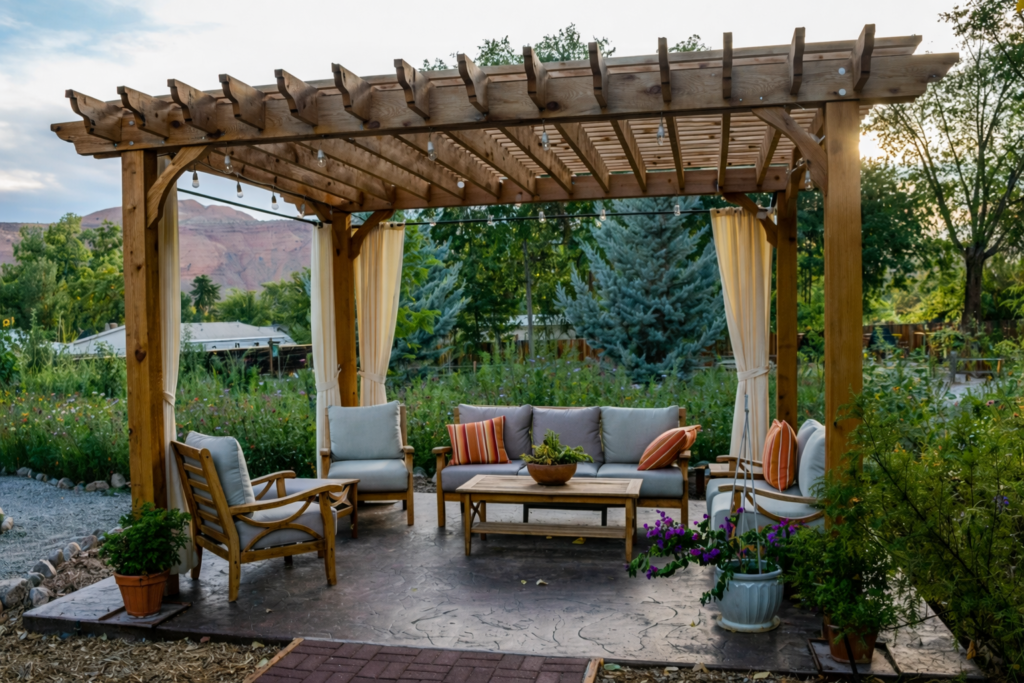
One of the most common mistakes Dubai homeowners make when planning a pergola is getting the size wrong. Either the structure ends up too small to provide meaningful shade, leaving most of the terrace or pool area still exposed to the brutal afternoon sun, or it ends up too large and dominates the garden in a way that feels completely out of proportion with the surrounding space. Getting the size right is not complicated, but it does require thinking through a few important factors before you finalise any design with your installer. Here is a practical, honest guide to choosing the right pergola size for your Dubai outdoor space.
Start With What You Actually Want to Cover
The most logical starting point is defining the area you genuinely need to shade. Walk your outdoor space and think carefully about how you use it throughout the day. Is the primary goal to shade an outdoor dining table and seating area? To cover the pool deck so sunbeds stay comfortable in the afternoon? To create a shaded lounge zone for family evenings? To protect patio doors and glass walls from direct afternoon sun that heats the interior? Each of these use cases has different size implications, and being clear about your primary goal drives most of the sizing decisions that follow. Our team at Modern Shade discusses intended furniture layouts and daily use patterns during every pergola work Dubai site visit to ensure the final design truly reflects how the space will be lived in.
Allow Generous Clearance Around Your Furniture
For outdoor dining areas, a practical rule of thumb is to allow at least 60 to 90 centimetres of clearance around your table and chairs on all sides. A dining table seating eight people typically measures roughly 2.4 by 1.2 metres, which means you need a pergola footprint of at least 3.6 by 2.4 metres to provide comfortable coverage with adequate room to pull chairs in and out. If you want the space to feel generous rather than tight, always scale up from those minimum dimensions. For outdoor lounge areas with sofas and coffee tables, allow similar clearance margins around the furniture group. A well-proportioned outdoor pergola installation always feels right because the scale was considered carefully at the design stage.
Account for Sun Angle, Not Just Overhead Coverage
A flat-roof pergola provides shade directly beneath its footprint, but the Dubai sun moves significantly across the sky throughout the day and changes position across the seasons. In the morning, low-angle sun arrives from the east. In the late afternoon, it comes from the west. In summer, the sun sits almost directly overhead at noon, but in winter it stays much lower in the sky throughout the entire day. All of these factors affect how much of your outdoor space actually sits in shade at any given time of day.
Low-angle afternoon sun can still penetrate underneath a pergola from the open sides, particularly during the cooler months when the sun stays low. This is precisely where side screens become a valuable addition to any pergola installation in Dubai — and it is also why a slightly larger footprint is often worth building in from the start. More roof coverage gives you better protection against low-angle sun reaching beneath the structure from the sides, particularly during the afternoon hours when outdoor spaces are most valued.
Consider Your Garden’s Overall Proportions
A pergola that is technically the right size for the furniture it covers can still feel visually wrong if its proportions do not work within the wider garden context. In a compact villa garden, an oversized pergola can overwhelm the space, leaving too little room for planting, lawn, or the other garden elements that give the outdoor space its character and life. In a larger estate garden, a very small pergola can look lost and insignificant against the scale of the surroundings.
A useful design guideline is that a pergola should occupy roughly 30 to 50 percent of the total usable garden area. In a 10 by 8 metre garden, a pergola of 5 by 4 metres feels balanced. In a 20 by 15 metre garden, a 10 by 6 metre structure sits naturally in the space. These are starting points rather than rigid rules, but they give you a sensible framework for thinking about scale. Our designers at Modern Shade apply these proportional principles when developing concepts for every pergola supply and installation project across Dubai.
Poolside Pergolas Need More Space Than You Think
Poolside pergola sizing in Dubai requires more generous planning than a simple terrace canopy. Most Dubai pool owners want shaded sunbeds, a shaded dining area, and often a shaded outdoor kitchen or bar counter — all connected under one coherent structure. When you add these elements together, the footprint required is often considerably larger than clients initially expect when they first start thinking about the project.
For a standard Dubai villa pool, a pergola covering the long side with a depth of 3 to 4 metres is the minimum for meaningful sunbed shade. Add a dining zone at one end and the structure can extend to 8 to 12 metres in total length. An L-shaped or corner configuration can provide coverage across multiple aspects of the pool area without creating a structure that completely encloses the pool. Our pergola builders across the UAE have delivered poolside structures of every scale and configuration across Dubai villa communities and resort properties.
Height Matters as Much as Footprint
Pergola height is a dimension many clients overlook when first thinking about size, but it has a significant impact on both the visual character and the practical comfort of the finished structure. A pergola that is too low feels oppressive, can obstruct views from inside the house through terrace doors and windows, and restricts natural airflow beneath. A pergola that is too high loses its quality as a defined outdoor room and can look disproportionate against surrounding garden planting and boundary walls.
For most residential Dubai applications, a finished eave height of 2.4 to 2.8 metres is comfortable and well-proportioned — it creates the feeling of an outdoor room without feeling enclosed. For commercial hotel terraces and restaurant outdoor areas, eave heights of 2.8 to 3.2 metres feel more generous and appropriate for the larger scale of those spaces. Our team always discusses eave height as part of every design consultation.
Know the Structural Span Limits
Different pergola systems have different maximum span capabilities between support posts, and understanding these limits helps you plan realistic dimensions. Standard powder-coated aluminium flat-roof systems can typically span up to 5 to 6 metres between support posts without intermediate columns. For wider spans, additional posts or structural beams are required to maintain integrity and prevent deflection over years of thermal cycling. Bioclimatic louvered systems typically have manufacturer-defined bay spans of 4 to 7 metres, and multiple bays connect side by side to achieve wider total coverage. Our aluminium pergola installation team discusses all structural span parameters during every design consultation so your project is sized correctly from day one.
The Best Approach: A Free Site Visit
While all of the above guidance is genuinely useful for initial planning, the most reliable way to determine the right pergola size for your Dubai property is to have an experienced designer visit and walk the space with you in person. Dimensions on paper never fully capture the way the sun moves across your specific garden, the proportions of your villa facade, the positions of existing mature planting, or the view lines from inside the house — all of which inform what the right size and configuration actually is for your specific situation. Modern Shade offers completely free site visits across all Dubai communities and the wider UAE. Contact us today to book your free consultation and take the first step towards a perfectly proportioned outdoor space.