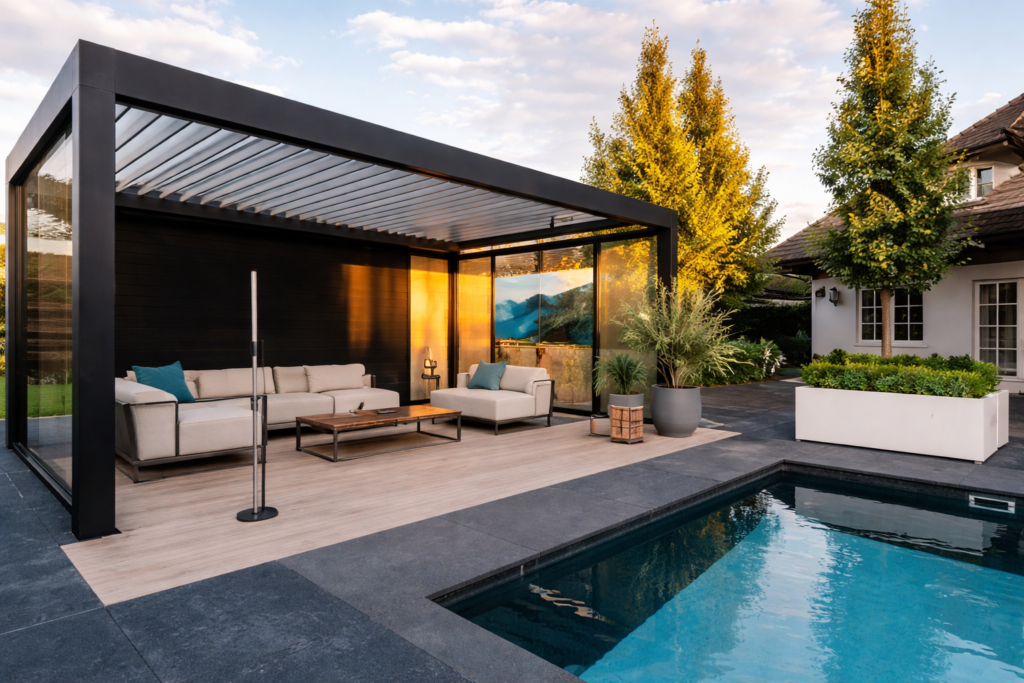
A pergola provides overhead shade, but it leaves your outdoor space open on all four sides. For many Dubai homeowners and commercial operators, this openness is one of the most appealing qualities of a pergola — the sense of being outdoors, connected to the garden, with air moving freely around you. But for others, the lack of side enclosure creates challenges: wind and sand blowing into the space, neighbouring properties overlooking your terrace, insects, and the feeling that the space lacks the defined quality of a true outdoor room. Pergola side screens solve all of these problems while preserving everything that makes a pergola great. Here is everything you need to know about side screens for Dubai pergolas.
What Are Pergola Side Screens?
Pergola side screens are vertical shading panels that can be deployed on one or more sides of a pergola structure, creating a partial or full enclosure. They come in several different systems with different aesthetic qualities, performance characteristics, and price points. The most popular options for Dubai pergola installations are zip-track roller screens, fixed fabric panels, decorative lattice screens, and glass or polycarbonate panels. Our pergola work in Dubai includes side screen specification and installation as a standard part of the design conversation for every project.
Zip-Track Roller Screens
Zip-track screens are the most popular side screen option for Dubai pergolas and the system we most frequently specify and install. A zip-track screen consists of a UV-resistant outdoor fabric that rolls up and down within a guided track system built into the pergola frame. The “zip” refers to the way the fabric edges lock into the guide channels, preventing the screen from billowing or flapping in wind — a critical feature in Dubai where Shamal winds can be strong and sustained. Zip-track screens can be motorized for convenience, allowing them to be raised or lowered via remote control or smartphone app, or manual with a simple strap mechanism for more budget-conscious projects.
The fabric itself is available in a wide range of colours and opacity levels, from highly sheer screens that filter light and reduce glare while maintaining outward views, to semi-opaque screens that provide significant privacy and solar control, to fully opaque blackout screens that close off the space entirely when privacy or full enclosure is needed. Our outdoor pergola installation service includes zip-track screen specification and installation with fabric samples brought to every site visit.
Glass and Polycarbonate Panels
For clients who want side enclosure while fully maintaining visual openness — particularly for rooftop terraces where views are a primary asset — fixed or sliding glass panels are an excellent option. Frameless glass panels provide a near-invisible wind barrier that protects the space from wind without any visual obstruction. Polycarbonate panels offer similar visual transparency at a lower cost and with slightly better impact resistance. Both options are permanently fixed rather than retractable, and they are most effective when positioned on specific wind-exposed aspects rather than used on all four sides of the pergola, which can create a greenhouse effect in Dubai’s heat. Our pergola installation team in Dubai specifies glass and polycarbonate panels for rooftop and elevated terrace projects regularly.
Decorative Lattice and Trellis Screens
For timber pergola structures with a traditional or garden aesthetic, decorative lattice or trellis screens provide a beautiful side enclosure option. These screens are fixed panels built from a framework of timber or aluminium battens arranged in a geometric pattern that allows air movement and filtered light while creating a defined boundary to the pergola space. Trellis screens are particularly effective as supports for climbing plants — jasmine, bougainvillea, and passion flower all grow enthusiastically across trellis structures in Dubai’s climate, creating a living green screen that becomes more beautiful with every season.
Which Aspects Should You Screen?
Most Dubai pergola owners do not need to screen all four sides of their structure. In fact, screening all four sides tends to reduce airflow in a way that makes the space feel more enclosed than comfortable. The most common approach is to identify the specific aspects where screens provide the greatest benefit and limit screening to those sides. In Dubai, the prevailing Shamal winds come from the north-northwest, so a screen on the north or northwest aspect of a pergola provides wind protection on the most exposed side without closing off the more sheltered aspects. South and west-facing screens reduce afternoon sun penetration from low sun angles. Privacy screens are positioned on aspects that face neighbouring properties or public areas. Our pergola building team always analyses the specific exposure and privacy requirements of each project during the site visit before making side screen recommendations.
Planning Side Screens from the Start
The most important practical advice about pergola side screens is to plan them as part of the initial design rather than adding them after the structure is complete. Zip-track screen systems require guide channels to be built into the pergola frame during fabrication. Motorized screens require power supply connections routed during the initial installation. Even fixed trellis and glass panels need to be considered in the overall structural design to ensure the frame has the right fixing points and structural capacity. Adding side screens to a completed pergola is always possible, but it is more expensive and less clean-looking than integrating them from day one. Our pergola supply and installation team always discusses side screen requirements at the initial design stage to ensure a seamless, integrated result. Contact us today for a free site visit and consultation anywhere in Dubai.