When Dubai homeowners start researching outdoor shading solutions, two options consistently come up side by side: pergolas and awnings. Both provide outdoor shade. Both are widely installed across Dubai properties. But they serve quite different purposes, perform differently in UAE climate conditions, and suit different types of outdoor spaces and lifestyle requirements. This guide compares pergolas and awnings honestly so you can make the right choice for your specific Dubai property.
What Is an Awning?
An awning is a retractable or fixed fabric cover that extends outward from a wall or building facade, typically supported by folding arms or a cassette roller system. Awnings are most commonly attached above windows, patio doors, or terrace openings to provide shade immediately outside those openings. Retractable awnings can be rolled back when shade is not needed, allowing full sunlight and open sky when preferred. They are available in a wide range of fabric colours and patterns and in motorized or manual operation configurations. In Dubai, awnings are a popular shading solution for apartment balconies, ground-floor terrace doors, and small outdoor seating areas where a compact, wall-attached shading solution is more practical than a freestanding structure.
What Is a Pergola?
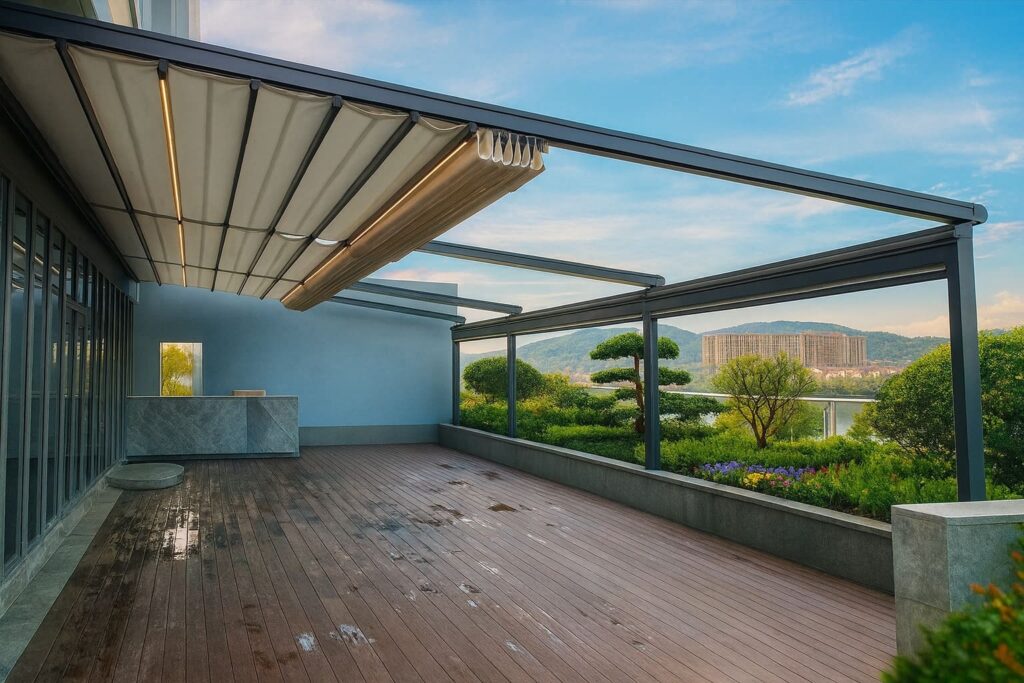
A pergola is a permanent structural outdoor shading system with its own framework of posts and beams, supporting a roof of various types including solid aluminium panels, adjustable louvres, fabric canopies, or timber slats. Unlike an awning, a pergola is a self-supporting structure that defines a specific outdoor space rather than simply extending shading from a building wall. Pergolas are significantly more substantial than awnings, considerably more durable in Dubai’s climate, and capable of covering much larger areas. Our pergola work in Dubai covers the full range of residential and commercial pergola systems across every property type in the UAE.
Coverage Area: Pergola Wins Clearly
The most significant practical difference between awnings and pergolas in Dubai is the area each can cover. A typical retractable awning has a maximum projection of 3 to 4.5 metres from the wall and a maximum width limited by the structural capacity of the wall attachment and the folding arm system. For most Dubai terrace situations, this means an awning can shade an area of perhaps 3 by 4 metres at most. A pergola, by contrast, can be designed to any size the site allows — covering pool decks of 12 metres or more, wrapping around multiple aspects of a garden, and creating covered spaces that genuinely define an outdoor room rather than simply extending a strip of shade from the building wall. For Dubai homeowners who want to shade a meaningful outdoor living area, a full outdoor pergola installation is almost always the more appropriate solution.
Durability in Dubai’s Climate
Awning fabrics in Dubai are subject to intense UV radiation, frequent sandstorm exposure, and occasional strong wind events. Quality outdoor awning fabrics rated for UAE conditions typically last 5 to 8 years before colour fading, fabric degradation, and reduced water resistance make replacement necessary. The mechanical folding arm systems in retractable awnings also require periodic maintenance and can fail if not regularly serviced. A quality aluminium pergola, by contrast, typically lasts 20 to 25 years with minimal maintenance beyond occasional cleaning. Our aluminium pergola installation service specifies UAE-rated powder coat finishes that maintain their colour and finish for many years under Dubai’s intense UV exposure — a very different lifespan proposition from an awning fabric that needs replacing every few years.
Wind Performance
Dubai experiences Shamal winds that can be strong and sustained, and awning performance in these conditions is a genuine limitation. Most retractable awnings have a wind speed limit beyond which they must be retracted to avoid damage — typically 30 to 40 kilometres per hour. In practice, this means that during many Dubai wind events, your awning needs to be retracted to protect it, leaving your outdoor space exposed at exactly the times when you most want protection from blowing sand and dust. A properly engineered pergola structure designed by experienced pergola contractors in the UAE is built to withstand Dubai wind loads and remains in place providing shade and enclosure during all but the most extreme weather events.
When an Awning Is the Better Choice
In the interest of honest guidance: awnings do have their place in Dubai’s outdoor shading market. For apartment balconies where there is no space or structural permission for a freestanding pergola, a motorized retractable awning is often the only practical shading option and is a genuinely good solution within its limitations. For small terrace areas immediately outside a single door or window where the primary need is simply to shade that opening during the afternoon, a compact awning may be more practical and cost-effective than commissioning a full pergola installation. The key is understanding what each solution can and cannot do, and choosing the right tool for the specific requirement.
For Most Dubai Homeowners: Pergola Is the Better Investment
For most Dubai villa owners and commercial property operators who are making a genuine long-term investment in their outdoor space, a pergola consistently delivers better performance, longer lifespan, greater coverage, and more value than an awning. The higher upfront cost is offset by a 20-year lifespan versus 5 to 8 years for an awning, better wind performance, greater coverage area, the ability to integrate lighting and accessories, and the genuine transformation of the outdoor space into a defined, functional outdoor room. Contact Modern Shade today for a free site visit anywhere in Dubai to discuss the right outdoor shading solution for your property. Visit our pergola builders UAE page for more about our complete design and installation service.